Origins of the House of Saszowski von Schassowe — Imperial Roots and Dynastic Ascent
Our noble House, the House of Saszowski von Schassowe, is rooted in the high-medieval lands of the Kingdom of Germany within the Holy Roman Empire, with our earliest appearance in the historic lands of Saxony within the Burgraviate of Meißen (Misnia), a principal centre of the Empire’s eastern frontier marches. It is there, serving in knightly and noble standing within this imperial frontier jurisdiction and royal administrative seat, that our forebears are attested in twelfth‑century imperial charters and deeds during the reign of Emperor Frederick I Barbarossa. As a House of the German Uradel, our heraldic identity reflects a lineage of continuous noble standing, earliest recorded within the medieval Kingdom of Germany and carried across the centuries in a tradition that has endured for more than nine centuries to the present day.
Across the generations, our forebears were recorded among the generosi et nobilissimi domini and milites—most noble and high‑born lords and knights—recognised in the records for their valour and for upholding the martial traditions of the imperial knightly estate. In the centuries that followed, successive generations served as royal burgraves and held office as imperial and royal envoys, chamberlains, councillors, ecclesiastical dignitaries, and officers of state within the realms of the Kingdom of Germany, the Holy Roman Empire, the Kingdom of Bohemia, the Margraviate of Moravia, the Duchies of Silesia, and the Kingdom of Poland. From these early centuries onward, our House remained continuously engaged in the civic, martial, diplomatic, and cultural life of Central Europe. Beyond the martial and civic spheres, our House was further distinguished through ecclesiastical office, with members serving as bishops, prioresses, and monastic superiors.
The history presented here offers a concise introduction to our enduring heritage, preserved through our private House archives, medieval chronicles, and imperial, royal, and episcopal deeds. These episodes represent only a small selection from a documented history extending across many centuries, the full breadth of which lies beyond the scope of this introductory account. Our House, a noble lineage of the Holy Roman Empire and of the Central European high nobility, has long been recognised by its distinctive headless Eagle coat of arms and by centuries of recorded service within the dynastic, ecclesiastical, and knightly traditions of Central Europe.
The Etymology of Our Territorial Predicate
Across the medieval and early modern centuries, the principal territorial predicate of our House—rooted in the German allodium and lordship of Schassowe—appeared in several historical forms. In Latin noble‑chancery usage it occurs as de Schassowe; in German noble style as von Schassowe (pronounced von Skassov); and—reflecting our presence across Bohemia, Moravia, and Silesia—in the German–Slavic vernacular forms Schassowsky, Schaschowsky, Ssassowsky, and the variant Schaszowsky. These spellings combine German orthographic practice, including the characteristic long‑s (ſ) and double long‑s (ſſ), with the Slavic noble adjectival suffix ‑sky / ‑ski, which, while historically associated with noble lineages, became more widely adopted from the seventeenth century onward.
In fully Latinised epigraphic and ecclesiastical contexts it occurs as Sasovius, reflecting the classical practice of adapting the territorial root Schassowe into a declinable Latin form.
As the cultural and administrative landscape of Silesia and its neighbouring Bohemian, Moravian, and Polish‑influenced regions evolved over the centuries, our predicate gradually assumed, within these territories, more fully Slavicised forms such as Szassowski von Szassow, Szassowski, Szaszowski, and ultimately Saszowski. Parallel phonetic softening is reflected in the related variant Szaszewski. Each of these forms preserves the same underlying territorial root, while their evolution reflects the region’s gradual transition through early Slavic phonetics, German and Bohemian scribal practice, and finally into the Polish noble adjectival tradition—mirroring our enduring presence along the historic cultural frontier known as Germania Slavica.
Beyond these principal forms, members of our House were identified by the names of the various allodial domains and lordships—lands, economic rights, and dependent rural communities—acquired throughout our history. These territorial designations reflected the extensive seigneurial authority our House possessed and governed across the historically bilingual regions of Silesia and the neighbouring Bohemian and Polish lands. In Silesia, for example, our allodial possessions of Wilamowice (Wilamowitz), Palczowice (Palczowitz), and Gierałtowice (Geraltsdorff, Geraltowitz) exemplify the lands and jurisdictions from which the locative by‑names and territorial predicates that follow were derived.
In accordance with regional noble custom, our territorial predicates and locative by‑names shifted as the members of our House held, inherited, or relocated between our various lordship seats. A member might therefore appear in the Slavic lands as Schassowsky z Wilamowic (“Saszowski of Wilamowice”), the particle z serving as the Czech and Polish equivalent of von in denoting territorial lordship, or alternatively under the adjectival form Wilamowski. Our lordship of Palczowice gave rise to the forms Schassowsky z Palczowic, Palczowski, Pałczowski, and the softened Polish variant Palczewski. From our lordship of Gierałtowice emerged Schassowsky z Geraltowic, Geraltowski, and Gierałtowski; in Czech usage this appears as Geraltovský z Geraltovice. In neighbouring German‑influenced territories, hybrid constructions such as Geraltowsky von Geraltowitz are further historical attestations of this practice.
Together, these forms illustrate how the identity of our House remained inseparable from its territorial jurisdictions. These variations were not mere aliases, but formal expressions of the specific lordship and authority exercised.
While numerous territorial designations emerged from the various lordships held in allodium by our House, our lineage has remained principally identified by its ancestral territorial predicates—von Schassowe in its German form and Saszowski in its fully developed Slavic adjectival form. Preserved in accordance with the longstanding German–Slavic bilingual traditions of the region, these principal predicates continue to signify the unbroken historical continuity of our noble lineage across the centuries.
Our House Cognomen Schaschor / Szaszor / Saszor
Alongside the territorial predicates derived from our allodial lands, our lineage also bore a distinct hereditary house‑name. In earlier Germanic orthography it appears as Schaschor, while in transitional and later Slavic‑Polish usage it occurs as Szaszor and Saszor. Although ultimately rooted in our ancestral territorial name, this form did not function as a territorial predicate. Instead, it served as a lineage‑wide cognomen, used after a member’s forename to signify that they belonged to our House by descent—much as a hereditary Roman cognomen identified the family line within a gens. In several sources it replaces our territorial predicate entirely, serving the same identifying function: marking the individual as a member of our lineage by descent, just as our territorial predicate does by reference to our ancestral seat. Its persistence across German and Polish forms reflects the bilingual cultural environment of Silesia and the neighbouring Bohemian and Polish lands, and illustrates the parallel naming traditions through which our family expresses its identity.
Imperial Service in the Burgraviate of Meißen — The Saxon Foundations of Our House
Our noble House finds its earliest attestations within the sphere of the Burgraviate of Meißen—a royal office established in 1068 under Henry IV, King of Germany and later Holy Roman Emperor, to administer the sovereign castle and town of Meißen and to exercise royal authority throughout the burgravial jurisdiction. Though distinct from the territorial principality of the Margraviate of Meißen, the Burgraviate formed the principal seat of royal authority in the region, and it was here that our ancestral castle and allodial lordships were situated, serving as a vital outlying defence of the imperial stronghold and its eastern frontier marches.
Within this framework, our House—rooted in the territorial nobility as hereditary knights and lords—stood in loyal service to Burgrave Hermann I von Sterker-Wolfeswach, and later to Meinher I and Meinher II von Werben, successive imperial Burgraves of Meißen. As members of the Burgrave’s knightly retinue, our forebears stood in close attendance within his court, acting as trusted counsellors and arbiters in judicial matters. Our House accompanied the Burgraves in their official capacities, bearing witness to imperial and royal charters, property exchanges, and administrative grants, and supporting the governance of the imperial stronghold. Alongside these administrative and judicial responsibilities, our House maintained and commanded its own armed retainers in service to the defence and public order of Meißen and its frontier territories.
This dual role—combining military duty with administrative authority—positioned our House among the territorial noble lineages upon whom imperial governance in Saxony depended. Such service placed our House within the established networks of service and trust through which rulers, and later sovereigns across neighbouring realms, governed and defended their territories.
From this Saxon foundation, long established within the imperial sphere of Meißen by the twelfth century, the responsibilities entrusted to our House expanded considerably. In the centuries that followed, our House was entrusted by Kings and Emperors with imperial and royal offices and dignities across the Crown of Bohemia, the Margraviate of Moravia, the Duchies of Silesia, and the Kingdom of Poland—appearing in military, administrative, and courtly capacities in recognition of our long-established standing within the territorial nobility and knightly estate of Saxony.
Heraldic Identity — The Eagle Decapitata and the Royal Augmentations of Our House
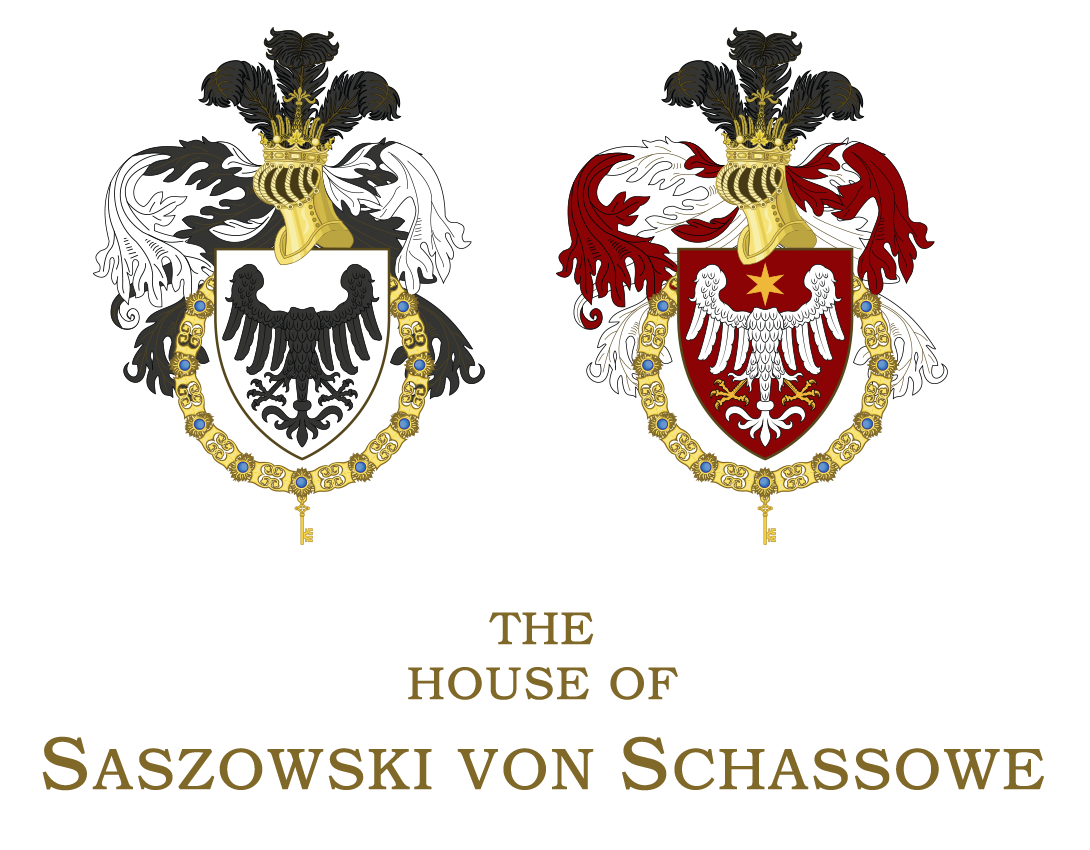
Our hereditary coat of arms finds its inception in the High Middle Ages, when our noble House—rooted among the domini et milites (lords and knights) of Saxony—came to bear the Imperial Eagle during the reign of Frederick I Barbarossa, Holy Roman Emperor. In its earliest form—Argent, an eagle displayed Sable—the Eagle was borne as a mark of the direct imperial tenure of our House, reflecting both our place within the imperial order and our service alongside the imperial Burgrave of Meißen, the foremost representative of royal and imperial authority in the Saxon border marches.
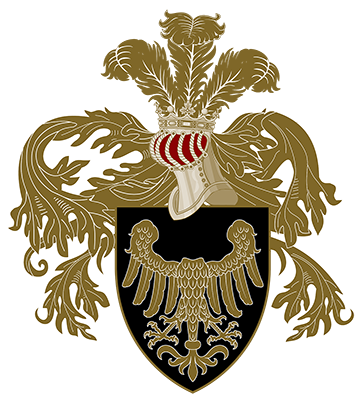
A later chapter in our history brought a significant change. A succession dispute among the noble brothers of our ancestral patrimony culminated in the death of one brother, and the judgment—while acquitting our surviving forebear of the alleged deed—nonetheless imposed a heraldic abatement upon our House, decreeing that he and his successive descendants bear the Eagle headless: Argent, an eagle displayed head couped Sable. From that epoch forward, the Headless Eagle remained the defining arms of our House, appearing upon the seals, banners, and shields of our forebears across successive centuries of military and territorial service.
From the Imperial Eagle to the Royal Bohemian Augmentation
In the decades that followed, our forebears upheld and renewed the honour of our House through loyal and eminent service. This legacy of courage was formally recognised in 1297, when Henry III the Faithful, Duke of Silesia and Lord of Głogów, posthumously honoured our House for the fearless bravery it had shown during the 1241 campaign surrounding the Battle of Legnica (also known as Liegnitz or Wahlstatt). In doing so, he recognised and rewarded the noble houses whose forebears had answered the urgent plea of his late grandfather, Henry II the Pious, Duke of Silesia and High Duke of Poland, for reinforcements to repel the first Mongol invasion of Poland.
There, our forebears rode at the forefront of the Bohemian–Saxon vanguard of mounted knights dispatched by King Wenceslaus I of Bohemia—a substantial and seasoned force sent in answer to Henry II’s call for aid. It was this vanguard that met and routed the Mongol detachment sent against them.
This pivotal stand in defence of Central Europe reaffirmed the long‑established place of our House among the foremost of the knightly elite. In the immediate aftermath of the campaign, King Wenceslaus I of Bohemia recognised the austere dignity of our headless Eagle and decreed that its fearsome aspect was no mark of shame, but a testament to the enduring fortitude of our House.
Thus, what had once been imposed as a mark of censure became, in the eyes of the King, a mark of renewed royal favour.
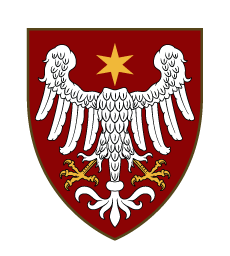
In an act of royal grace, he authorised a sacred augmentation: a six‑rayed star of gold to be set upon the neck where the Eagle’s head had once been, together with a solemn change of tincture. This transformation from the Sable (Black) of our origins to the Gules (Red) of our later achievement was a profound symbolic renewal. Through the golden star and the granting of the Red field—the colour of defensive valour, princely favour, and sovereign magnanimity—the King affirmed the honour of our shield and transmuted its earlier judgement into a mark of royal esteem.
This sovereign alteration of tincture formally integrated our House into the high heraldic tradition of the Kingdom of Bohemia, aligning our colours with the Royal Livery. Where the original black eagle on silver reflected our Saxon standing within the Imperial order, the red and silver of our later arms signal a history of renewed honour and the enduring proximity of our House to the Bohemian Crown. It embodies a living heraldry: a shield that bears the memory of medieval trial while reflecting the renewed light of royal favour.
Our arms thus took the sovereign form we bear today:
Gules, an eagle displayed head couped Argent, charged on the neck with a mullet of six points Or, and membered Or.
This heraldic distinction is further reflected in prestigious medieval armorials, most notably the fifteenth-century Grand Armorial équestre de la Toison d’Or et de l’Europe. Compiled under the authority of Jean Le Fèvre de Saint-Remy, King of Arms of the Burgundian Order of the Golden Fleece, and now preserved in the Bibliothèque de l’Arsenal in Paris, this monumental manuscript records our headless Eagle among the heraldic ranks of Europe’s knightly elite. Its inclusion stands as enduring testimony to the recognised presence of our House within the heraldic and knightly tradition of medieval Europe.
Alongside this sovereign augmentation, our House continued to prize the original headless Eagle of imperial German bearing beside its later augmented form. Across the generations, we have regarded the Eagle decapitata as the truest expression of our heraldic identity—an emblem whose austere bearing and uncompromising dignity reflect the way our House has understood its own continuity.
Polish Naturalisation — The Saszor Arms and the Polonisation of Our Heraldic Tradition
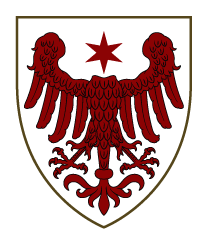
Distinct from our personal imperial German and royal Bohemian arms, when our noble House extended and established its standing within the Polish realm during the late thirteenth and early fourteenth centuries—initially under the Bohemian Crown and subsequently under the restored Polish Kingship—our personal Bohemian arms underwent a territorial naturalisation and adaptation of tincture to align with local custom. This gave rise to a distinct Polish expression of our long-established heraldic identity, intended specifically for our presence within that realm, without prejudice to our senior German and Bohemian armorial traditions.
Foreign noble houses entering the Polish realm typically retained their personal arms while adopting a Polish‑style variant suited to the local, minimalist heraldic tradition—a sophisticated process of “Polonisation”. This transition was initiated by our House itself, shaped by the burgeoning Polish heraldic culture, and ultimately fixed in the earliest armorial records and seal-rolls of the period.
In the tradition of our noble House, our Polish coat‑of‑arms form—recorded in armorials under our ancestral cognomen as Schaschor, later Saszor (Szaszor)—appeared as: Argent, an eagle displayed head couped Gules, charged on the neck with a mullet of six points Gules.
This tinctural form did not replace our personal imperial German or royal Bohemian arms; rather, it served as the Polish expression of our long-established heraldic identity, borne alongside them as part of a unified dynastic tradition. Throughout the historical record, our Saszor arms remained the personal and exclusive Polish arms of our noble House, even as the same coat of arms later came to be known more broadly under the name Orla with the evolution of the Polish heraldic system toward a fraternity‑based model.
The Saszor Progenitorship — Origins of the Orla Heraldic Fraternity
As was characteristic of the Polish Piast and Jagiellonian eras, the coat of arms of a prominent noble house could, through kinship ties, military service, and political alliance, develop into the emblem of a broader heraldic fraternity. Over time, the Saszor coat of arms of our House followed this path, gradually extending beyond our immediate lineage and forming the progenitorial nucleus (protoplasta) of a wider knightly fraternity within the Polish nobility.
In later decades, this same emblem came to be known under the descriptive name Orla (“the Eagle”). The change was one of designation rather than design: Saszor is the house‑specific name borne by our noble House, while Orla is the fraternity name adopted as the arms came to be borne more widely by allied and affiliated Polish noble families. Both names refer to the same heraldic sign—the former marking its origin, the latter its broader knightly fraternity.
The Right of Heraldic Co‑optation — The Expansion of the Orla Heraldic Fraternity
As the originating lineage of the Saszor coat of arms within the Polish realm, our noble House held a position of seniority within the heraldic fraternity that later formed around this emblem. In the Polish heraldic tradition—distinct from the individualised, lineage‑specific heraldry of Western Europe—the coat of arms functioned as the symbol of a heraldic brotherhood, into which additional families could be incorporated through custom, service, and royal recognition.
From the late medieval period into the early modern era, our House exercised, on rare and carefully chosen occasions, the customary Polish practice of heraldic co‑optation (współherbowość). This legally recognised tradition allowed a noble lineage to extend its Polish heraldic arms to deserving individuals—typically distinguished soldiers, loyal retainers, or allied families whose service merited inclusion within the heraldic fraternity shaped by our House. Such acts were undertaken with the recognition or confirmation of the Polish Crown, in accordance with the legal norms of the time.
This affiliation was not merely symbolic; it was a solemn gesture of fraternal admission. By admitting an individual to our Polish arms, our noble House, as the progenitor of the arms, extended to the adoptee the honour, protections, and noble privileges that the bearing of the shield conferred within the Polish realm. Yet this affiliation was strictly circumscribed by Polish custom:
- Authority of the Progenitor: As the originating lineage of the Saszor arms, our noble House possessed the senior authority to vouch for the worthiness of those admitted to our heraldic fraternity.
- Separation of Patrimony: Heraldic affiliation conferred the right to bear our Polish arms and enjoy the privileges of the Polish nobility, but conferred no claim upon our patrimonies, dignities, or blood inheritance.
- Royal Confirmation: While initiated by our House, such affiliations were formalised through recognition by the Polish Crown, ensuring their full legal standing.
Through these selective acts of patronage, our noble House played a direct role in shaping the Polish nobility, expanding the heraldic fraternity that later came to be known under the name Orla. Yet throughout this evolution, our House remained the sole hereditary custodian of the original Saszor arms from which the fraternity derived.
Although the Orla name became associated with a wider heraldic community, it is essential to distinguish heraldic affiliation from blood descent. As in all Polish heraldic traditions, the later bearers of the Orla arms were not, in the main, genealogically related to our noble House, nor did they possess any claim upon our lineage, territorial lordships, dignities, or patrimony. Their connection was heraldic rather than familial—an affiliation to the Orla coat of arms, not to the bloodline that had originated it.
In later centuries, however, the Orla arms were also adopted—indeed, usurped—without warrant by certain aspiring individuals who possessed neither grant nor hereditary claim to these specific Polish heraldic arms. Such unwarranted adoption, often termed “heraldic self‑assumption”, was a byproduct of the Polish principle of noble equality. Yet it remains entirely distinct from the indisputable hereditary right maintained by our noble House through centuries of continuous heraldic usage, attested by both physical monument and historical record.
Royal Office and High Service under the Bohemian Crown
With our noble House long established among the German territorial nobility of Meißen, our standing within the Imperial order formed the foundation upon which our influence extended into the Crown of Bohemia. The standing established through centuries of entrusted service alongside the Imperial Burgraves, together with the heraldic favour bestowed upon our House by King Wenceslaus I of Bohemia, positioned our lineage among those noble families whose loyalty and capability were esteemed far beyond their ancestral Saxon domains. As the political sphere of the Přemyslid kings expanded across Silesia, Moravia, and the Polish lands, so too did the sphere in which our House was called to serve.
It was within this wider orbit of royal authority that our House entered the service of King Wenceslaus II of Bohemia of the Přemyslid dynasty, whose reign brought the Kingdom of Poland under the Bohemian Crown. During this period of consolidation, the royal annals record that Duke Nicholas I of Opava—a prince of the Přemyslid dynasty—was removed from his tenuta and dignity as capitaneus of the Kingdom of Poland for oppressions laid against him. In his stead, King Wenceslaus II appointed our House as summus camerarius regni Polonie (Grand Chamberlain of the Kingdom of Poland), together with the dignities of the Bohemian royal Starosta and Capitaneus (Royal Governor and commander of the territory’s military forces) over the duchies of Kuyavia and Pomerania—royal offices ordinarily reserved for members of the Přemyslid royal line. Contemporary royal records, such as the 1302 Poznań charter issued by our House in its capacity as summus camerarius regni Polonie, attest to the authority vested in this office, including judicial, fiscal, and settlement powers exercised directly under the mandate of the King of Bohemia and Poland.
This extraordinary appointment marked the formal extension of the authority of our House into the northern crownlands. From this position of trust, our House served the Bohemian Crown in its campaigns and administrative governance across Silesia, Kuyavia, Pomerania, and the northern border marches, operating within the same sphere of royal confidence traditionally reserved for the Přemyslid princes.
The tradition of high service to the Bohemian Crown continued into the fifteenth century. In 1449, our House is likewise attested as serving in the dignity of royal Governor and Captain‑General (Lat. capitaneus; Cz. hejtman; Ger. Hauptmann) of the Silesian Principality of Pless (Fürstentum Pleß), and in the early seventeenth century this authority was extended under the Habsburgs in the Duchy of Krnov (Herzogtum Jägerndorf), both principalities of the Bohemian Crown. These appointments reaffirmed the longstanding trust placed in our lineage, extending our authority across key Silesian territories and sustaining the role our House held since the Přemyslid era within the administrative and military hierarchy of the Bohemian Crownlands.
Diplomatic Authority — Our House in the Polish–Teutonic Peace of 1343
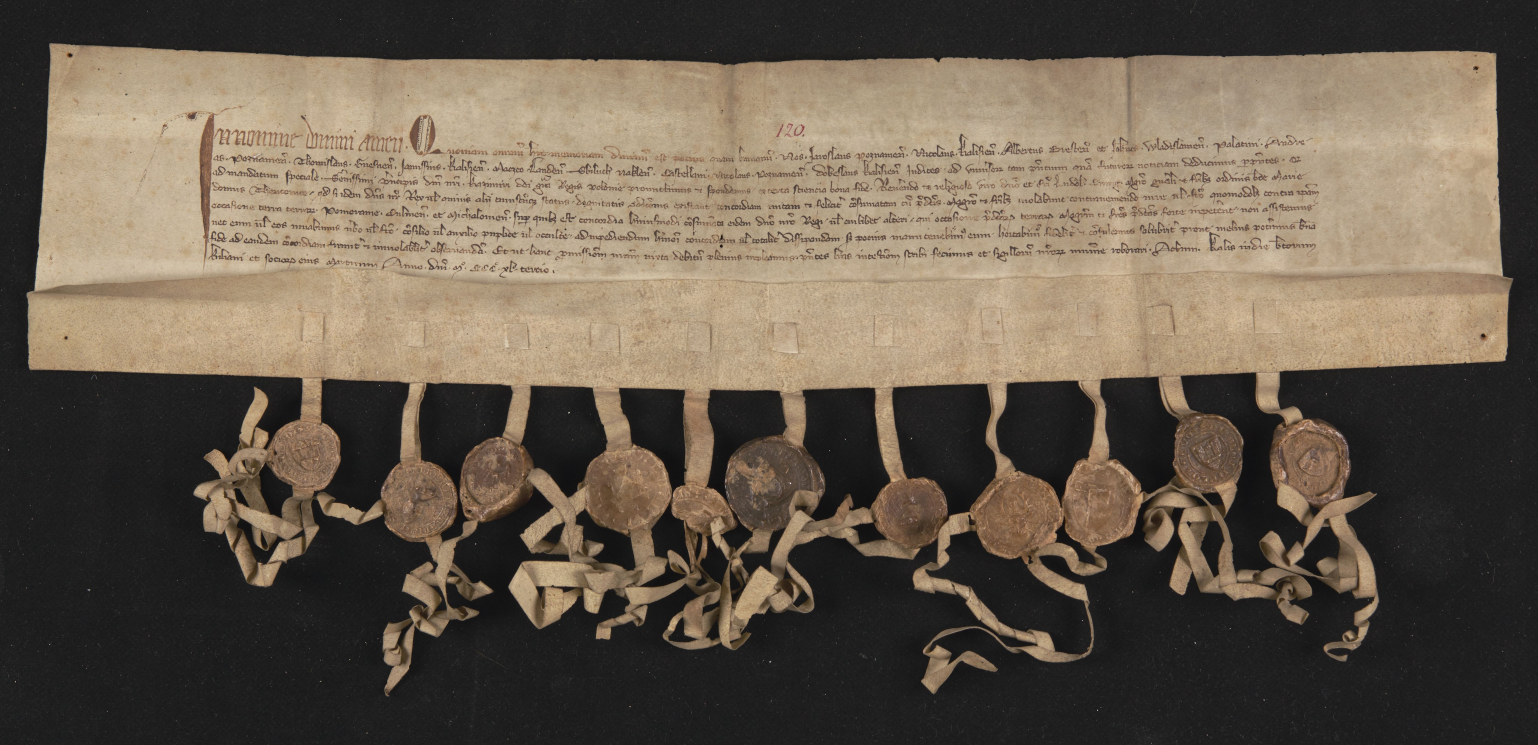
8 July 1343: Kalisz — Guarantee charter issued as part of the Polish–Teutonic peace agreement, bearing the third seal—the headless eagle and star of our noble House—marking our House as one of the designated guarantors of the peace between the Kingdom of Poland and the Teutonic Order.
By the fourteenth century, the documented activity of our noble House extended into the diplomatic and administrative sphere of the Kingdom of Poland. In 1343, by special command of King Casimir III the Great, our House was numbered among the high nobility of the duchies of Greater Poland and Kuyavia who were designated to provide a formal guarantee to Grand Master Ludolf König von Wattzau and the Teutonic Order. Although distinct from the treaty charter issued by the King, this guarantee charter formed an essential component of the Treaty of Kalisz settlement, created on the same day to secure the enforcement of the peace.
As one of only eleven high nobles commanded by Casimir III the Great to sign the pledge, our House vowed to withhold support from the Crown should the King attempt to breach the newly concluded peace treaty concerning Pomerelia (Eastern Pomerania), as well as the regions of Chełmno and Michałów—Piast‑Polish lands held by the Teutonic Order from the early thirteenth century (Chełmno and Michałów) and from 1308 (Pomerelia).
The Teutonic Order required the pledge to be sealed by our noble House together with ten other high nobles upon whose support the King of Poland depended for any military action. In the presence of Casimir III the Great and Grand Master Ludolf König von Wattzau, our House affixed its seal alongside the other designated magnates, placing it among this select group and demonstrating the influence and standing it held within the region. Rather than an act of disloyalty, the pledge served as a formal diplomatic instrument intended to stabilise a fragile peace after decades of conflict between the Kingdom of Poland and the Teutonic Order. In acting as a signatory, our noble House served as a guarantor of political order during a turbulent period of Polish–Teutonic relations.
Spytkowice and the Jagiellonian Crown — Frontier Authority and Ducal Politics
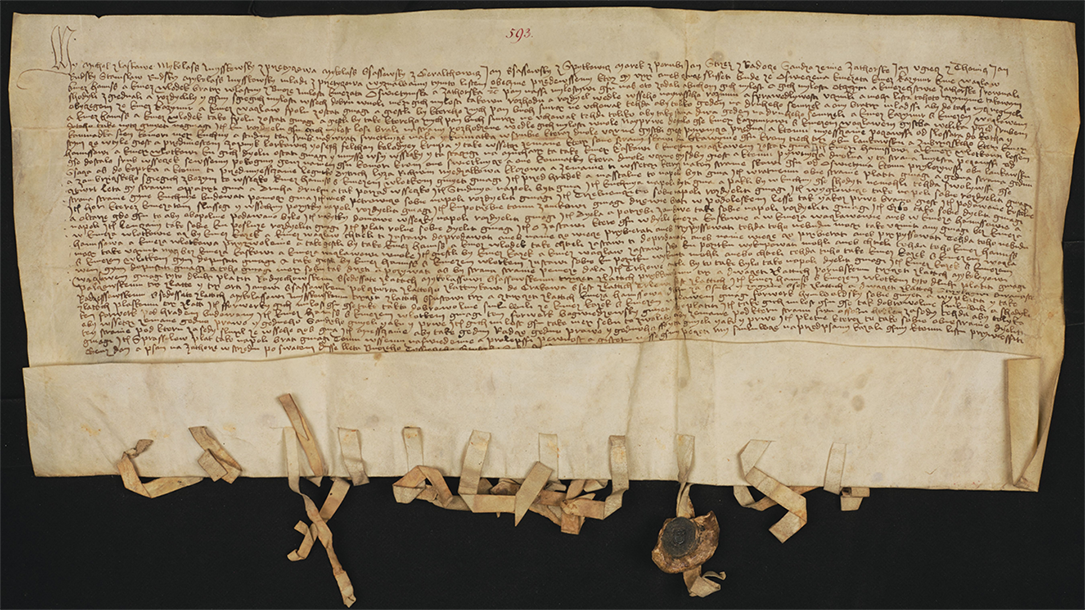
28 May 1477: Parchment charter of the Dukes of Zator recording the succession and formal partition of the Duchy of Zator. Among the eight principal nobles entrusted with determining the division of the duchy, two members of our House are named, reflecting our established role within the political order of the region. Of the ducal and noble seals originally affixed to the act, only a single seal has survived the passage of centuries.
By the mid-fifteenth century, our noble House had long been woven into the political and military fabric of the Oświęcim–Zator frontier—the shifting borderland between the Silesian Piast duchies and the Kingdom of Poland. Our presence in this frontier region is attested by 1436 within the Duchy of Oświęcim, by which time our House already held extensive estates and exercised a recognised role within the noble estate and territorial administration of this strategically contested region. This prominent standing is recorded again in the monumental constitutional charter of 1457, by which the neighbouring Duchy of Oświęcim was formally sold and resigned to King Casimir IV Jagiellon and the Polish Crown. In that historic act, our House appeared at the sovereign court as principal noble co-signatories and guarantors, underscoring our established authority within the high diplomacy of a fluid borderland where the Bohemian and the Polish Crowns met, overlapped, and contended. Within this environment of shifting sovereignties, the history of Spytkowice (Spikwicz) forms a significant chapter in the wider engagement of our House with the power dynamics of late‑medieval Central Europe.
Long before the Piast dukes of Zator pledged the lordship of Spytkowice to our House, the region lay within the old Kraków–Silesia frontier. Marked by early strongholds and watchtowers, it commanded major trade routes along the Vistula and Skawa river valleys. It was within this defensive landscape that the developing domain and its surrounding lands took shape.
From Ducal Debt to Hereditary Seigniory
The domain formally entered our history through the financial distress of the Piast dukes of Zator. Burdened by dynastic division and the economic strains of maintaining an independent principality, the dukes increasingly relied on substantial private credit secured upon their lands. When the ducal treasury could no longer meet its obligations to our House, Spytkowice passed into our hands as a possessory pledge (zastaw tenutaryjny).
While initiated as a debt security, the dukes’ prolonged insolvency effectively elevated the status of our tenure over the domain. By 5 June 1476, royal records explicitly style our House not merely as a temporary tenant, but as the dziedzic—the recognised hereditary lord and proprietor of Spytkowice—granting our House full seigneurial authority over a highly strategic frontier stronghold.
The 1474 Wartime Loan to the King
By 1471, a timber‑and‑masonry defensive manor already stood at Spytkowice, reflecting the domain’s strategic importance within the Zator principality and serving as the seat of the domain’s local administration. At nearly the same time, our House was active in the wider geopolitical conflicts of King Casimir IV Jagiellon’s Silesian campaign. On 30 July 1474, alongside the closely related House of Myszkowski, our House advanced a critical wartime loan of 1,510 Hungarian gold florins directly to the Polish king—a substantial sum sufficient to mobilise and sustain several hundred elite mounted mercenaries for an entire campaigning season.
The royal charter, issued in Nowe Miasto Korczyn and written in the Bohemian chancery language, was witnessed by the starosta of Krzepice, the castellan of Żarnowiec, and nobles of the Oświęcim region, alongside the town councillors of Oświęcim and Kęty. The document required the king to repay the loan by 2 February 1475, the Feast of Candlemas, either in Kraków or at Spytkowice itself.
This explicit geographic provision is highly significant: by naming Spytkowice alongside the capital of Kraków, the royal chancery provided formal, de jure recognition that the domain was fully under the control of our House and possessed the administrative security required to conclude a major crown financial transaction. Ultimately, this transaction serves as a clear indication of our influence, illustrating how the financial affairs of our House had become deeply intertwined with the geopolitical and fiscal concerns of the Polish Crown.
Although the 1474 charter required repayment by Candlemas of 1475, the Crown did not settle the debt on that date. Instead, later that same year the obligation was formally entered into the royal registers, where King Casimir IV bound himself to provide our House a substantial annual annuity, payable on the Feast of St John the Baptist, together with the restoration of the principal originally advanced. This reflects the standard Jagiellonian practice of converting wartime loans into long‑term royal annuities, thereby confirming that the 1474 loan was fully acknowledged, legally secured, and integrated into the fiscal commitments of the Polish Crown.
The 1477 Partition of the Duchy of Zator
Building upon an established presence that included the ownership of neighbouring Palczowice and other ancestral domains in the region, our House naturally assumed a central role within the internal governance and high politics of the Duchy of Zator. In 1476, our House appeared among the leading nobles petitioning the Piast dukes to confirm the rights and liberties of the local landholders.
This systemic responsibility culminated on 28 May 1477, when a parchment charter was executed by the Dukes of Zator to record the formal geopolitical partition of the sovereign duchy between the four sons of Duke Wenceslaus I. Our House is explicitly documented in this very charter as participating directly in the partition—a critical division that entirely reshaped the political order of Zator.
The significance of this event lies in the structural trust it represents: rather than acting as passive observers, our House held two of the eight seats on the arbitration commission of principal nobles entrusted by the sovereign dukes to arbitrate and execute this highly sensitive division of the principality. To be positioned as an arbiter over the sovereign lines of the Piast dynasty demonstrated both our pivotal regional authority and our diplomatic acumen. These actions reflect not a sudden elevation, but the steady, authoritative continuation of responsibilities our House had long exercised within a politically fractured frontier zone.
The Cistercian Border Dispute and the Ducal Decree
The boundary decree of 1478 further anchored our position. Following a dispute between our lordship of Spytkowice and the neighbouring lands of the Cistercian Abbey of Mogiła, the Piast dukes Jan and Kazimierz personally oversaw the boundary survey, directing the inspection of the contested frontier and issuing a detailed ruling that fixed the permanent border between Spytkowice and Ryczów. The ultimate “bone of contention” was a dense tract of forest and a valuable meadow known as Czadnycza, critical to the region’s lucrative carp-pond economy. The dukes issued a definitive, highly detailed legal ruling fixing permanent boundary mounds and land markers.
In their final judgment, the sovereign dukes firmly verified our rights, explicitly decreeing:
"...sic quicquid est et erit ad sinistram partem vie et scopulis pertinebit ad hereditatem Spitkowicze predicti... super quibus abbati et conventui de Mogila silencium imponimus..." ("...thus, whatever is and shall be on the left side of the road and the mounds will belong to the heritage of Spytkowice of the said... upon which we impose permanent silence on the abbot and convent of Mogiła.")
By commanding silencium upon the Abbey, the ducal decree legally barred the monks from ever challenging our claims again, permanently stabilising Spytkowice’s legal and geographic status.
The 1488 Transition and Broader Legacy
Our status as the recognised hereditary lord and proprietor of Spytkowice—granting our House full seigneurial authority over a highly strategic frontier stronghold and its vast expanse of plains and forests—is firmly stamped across this decade of governance, forming part of the many territorial holdings—both allodial and tenurial—held by our House across Bohemia and Silesia. As our House shifted its primary focus toward these broader regional holdings, the lordship of Spytkowice passed smoothly to the House of Myszkowski, our close affinal kin. In 1488, they provided the necessary capital to satisfy and liquidate the financial obligations owed by the dukes to our House, whilst simultaneously paying the ducal treasury to waive its right of redemption—thereby extinguishing the remaining claims attached to the pledge and converting it into a permanent hereditary seat, which they held within our wider familial network for nearly 130 years.
The 1499 Royal Confirmation
Our enduring authority within this frontier zone is further attested at the turn of the century, marked by direct proximity to the sovereign and our role as a vital creditor to the Crown. In 1487 our House acquired Lipnik—a substantial village‑estate in the Land of Oświęcim, corresponding to the modern Lipnik district of Bielsko‑Biała—as hereditary patrimony through a royal‑licensed purchase, while the Crown retained the advocatia, that is, the income‑bearing fiscal rights historically attached to the village. These rights would be pledged by King John I Albert in 1499 to secure repayment of a substantial royal debt owed to our House. In that year, the king assigned to our House—explicitly styled in the royal chancery as curiensi suo (his royal courtier)—the sum of 400 Hungarian gold florins, secured upon the advocatial rights in Lipnik. This significant royal assignment, coupled with the intimate court styling, reflects not only our continuous integration within the inner chambers of the Jagiellonian court, but also the formidable financial capacity of our House to advance capital to the Crown while maintaining a dominant hand in the regional administrative structures of the late‑medieval duchy.
Seen in its broader context, Spytkowice was not an isolated achievement nor a dramatic elevation, but part of a larger and enduring pattern. During this period, our House combined financial capacity, political participation, and legal acumen to maintain a stable and respected presence within a frontier zone shaped by shifting allegiances and competing sovereignties. The significance of Spytkowice lies not in grandeur alone, but in continuity: a testament to how our House navigated the complexities of the late medieval borderland and secured a lasting place within it.
The Royal Bodyguards — Trusted Companions of the Jagiellonian Kings
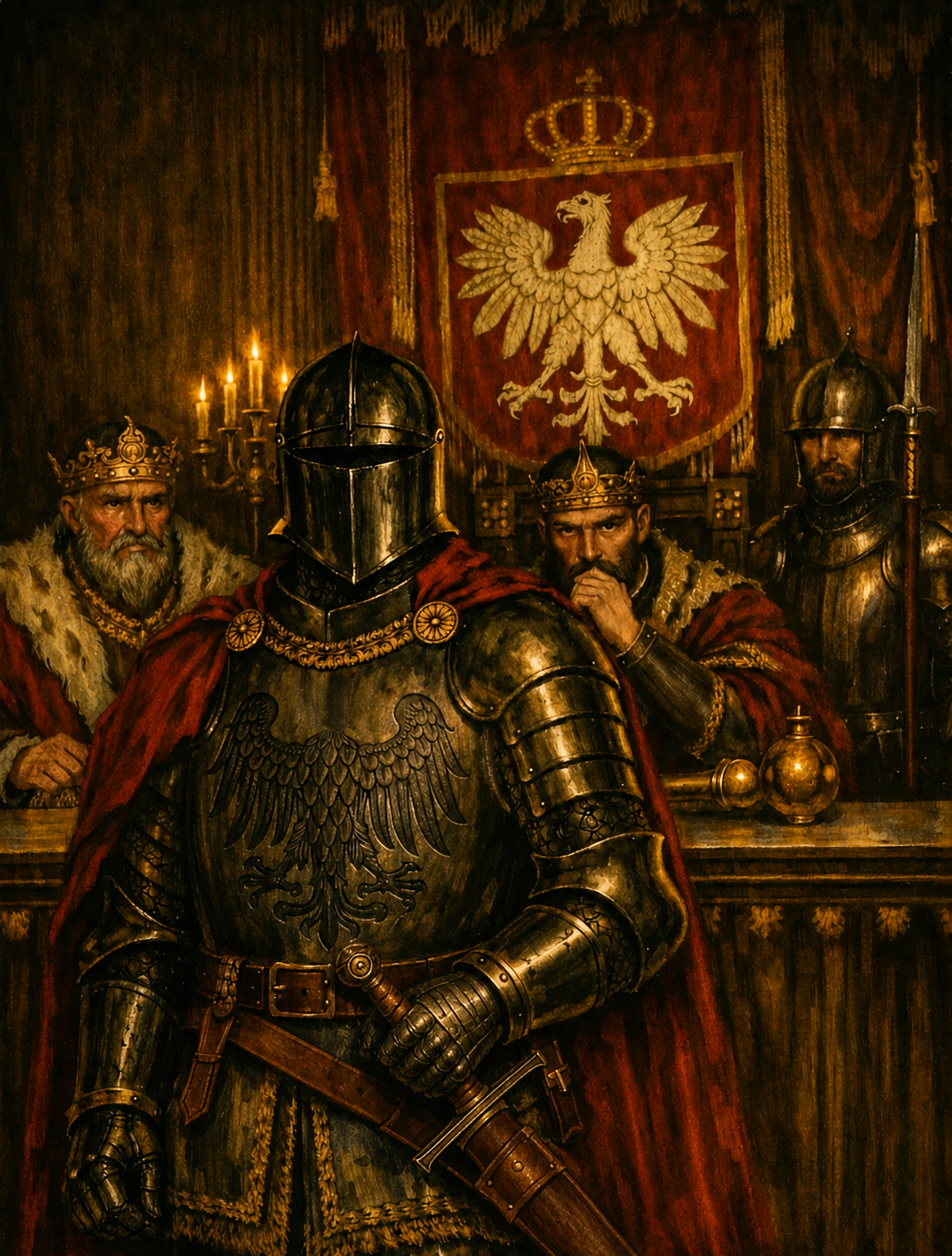
In the age of the Jagiellonian monarchs, this ancient tradition of trusted service attained a new distinction. Alongside our established role within the political and administrative life of the realm, our House remained in close attendance upon the sovereign, continuing the knightly tradition that had long defined our House from the courts of the German Emperors to those of the Kings of Bohemia and Poland.
Recorded in the Kraków Royal Treasury Register of 1543 among the Stipatores Regii—the royal bodyguard of the Jagiellonian court—our House is attested during the reigns of King Sigismund I the Old and Sigismund II Augustus. Within this select inner circle, our House held the prestigious command of Rotmistrz (commander), leading the mounted escort rota that formed the core of the Senior King’s personal guard. Such a position was reserved exclusively for trusted nobles and proven knights of the Jagiellonian royal court, reflecting generations of unblemished loyalty and placing our House in immediate and daily proximity to the royal person.
A later royal treasury register, entered at Vilnius on 3 September 1560, further distinguishes our House as stipator seorsim—a royal bodyguard set apart for a distinct royal charge—denoting a position of heightened responsibility and exceptional proximity to the reigning monarch, Sigismund II Augustus. Whereas the earlier record attests our House in command of the mounted escort rota of Senior King Sigismund I’s personal guard, the later register distinguishes our House anew, in direct attendance upon the Young King, Sigismund II Augustus. The elevated standing of our House within the Jagiellonian royal court is further affirmed by the extraordinary annual donative—conferred by His Majesty, in addition to the customary stipend for royal service—recorded as ultra stipendium… habet seorsim in anno from the treasury of the Serenissimus Rex iunior, Sigismund II Augustus.
Taken together, these archival entries demonstrate a deepening of royal confidence that transcended a critical dynastic transition. By operating at the right hand of both father and son across several decades, the position of our House evolved from a prestigious military command into a highly individualised, specially compensated trust. Through decades of faithful service, our House remained permanently bound to the security and immediate presence of the Jagiellonian sovereigns.
Royal Officers of Kraków and Wawel Castle — Guardians of the Crown and the Commonwealth
During the politically unsettled succession that followed the death of King Sigismund II Augustus, and through the reigns of King Henry of Valois, Queen Anna Jagiellon, and King Stephen Báthory, our noble House held the office of royal Vice-Starosta of Kraków (Latin: vicecapitaneus Cracoviensis; Polish: podstarości krakowski; effectively the deputy royal governor of the capital) and, within the broader tradition of service to the Crown, the Royal Burgraviate of Wawel Castle. This tradition of high office was rooted in a much older history: already in 1457, our House appears as Castellanus and Capitaneus of Kraków, holding these offices concurrently and serving as a senior royal officer in the deed of sale by which the Duchy of Oświęcim was transferred to King Casimir IV and incorporated into the Crown of the Kingdom of Poland. These were offices of significant royal trust and of high standing within the broader governance of the kingdom, encompassing administrative authority, judicial competence, and responsibility for the security of Kraków and the royal residence at Wawel Castle—then the administrative heart of the Polish realm and the seat of its highest governance.
The nature of these responsibilities is reflected in entries preserved in the Kraków Castle Court Books (Acta Castrensia Cracoviensia), where oaths taken by holders of these offices—including members of our House—record the formal obligation to safeguard Wawel Castle and to administer justice secundum ius scriptum… sine dolo et fraude (according to written law… without guile or fraud). These entries illuminate the legal culture of the Polish–Lithuanian Commonwealth and the expectation of principled governance at the royal seat.
The role of the office at a moment of dynastic transition is illustrated by an entry dated July 1572, which records the death of the King and is immediately followed by the oath of our House as Vice-Starosta of Kraków, taken at Kraków Castle in praesentia magnificorum et generosorum—before the assembled magnates and nobles of the realm, as was customary for public acts of high royal office. As preserved in the court books, this solemn vow commits the officeholder to guard Wawel Castle, uphold peace and justice, and exercise authority according to written law. This entry forms part of the earliest acts of the interregnum, reflecting the immense responsibility borne by members of our House in maintaining order and continuity at the royal seat during a constitutional crisis.
This commitment to the stability of the realm found its most profound expression in January 1573, when our House stood among the signatories of the General Confederation of Warsaw (Konfederacja warszawska), formally promulgated in Kraków on 28 January 1573. The act was subscribed by the senators, deputies, and assembled nobility of the Convocation Sejm—the political nation of the Commonwealth. As the landmark act of the interregnum, this document established a pioneering foundation for religious tolerance and civil peace, ensuring that the diverse state remained united. By affixing our seal to this act—now recognised on the UNESCO Memory of the World Register—our House helped define the “Golden Liberty” that would shape Polish constitutional life for centuries to come.
Chivalric Traditions of Our House
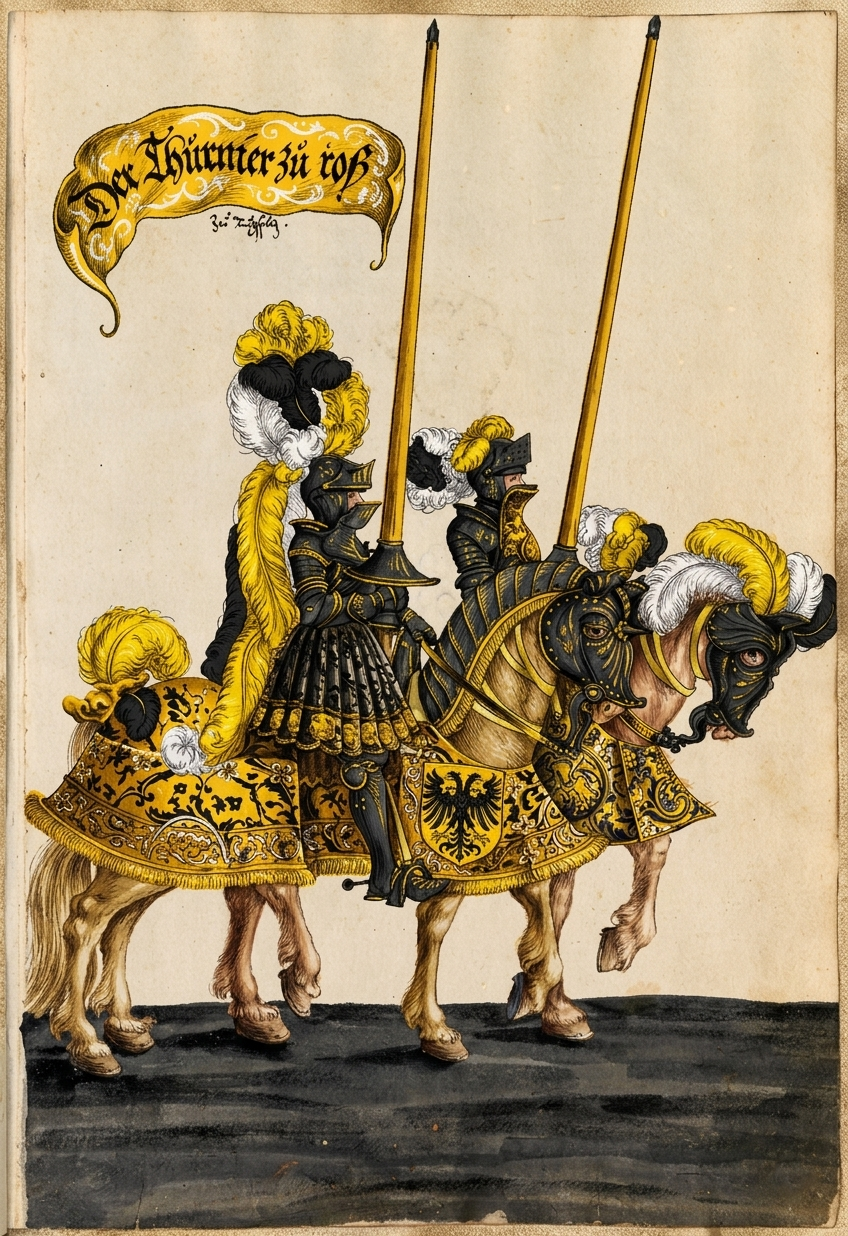
Knights in ceremonial tournament armour, from Hans Burgkmair’s "Der Thurnier zu Roß" (Augsburg, 1540), depicting the richly adorned style of Renaissance mounted jousts. Colourised to reflect the Imperial livery colours recorded as those borne by our House in the 1560 Vienna tournaments.
During the sixteenth century, our noble House was counted among the select knights personally marshalled under the authority of Ferdinand I, Holy Roman Emperor and King of Bohemia, and his eldest son Maximilian II, to represent the Crown of Bohemia in Imperial‑Royal knights’ tournaments. Of these appearances, documented in Renaissance chronicles and heraldic rolls, our House is recorded among the foremost combatants of the Vienna Tournament of 1560, serving among the Bohemian knights—a placement that reflected both the multi‑ethnic composition and the high prestige of the Habsburg realms.
The 1560 tournament, held under Ferdinand I’s newly consolidated imperial authority, marked a high point in the Habsburg revival of chivalric pageantry. Staged in honour of the visit of Duke Albrecht V of Bavaria—son‑in‑law of the Emperor and brother‑in‑law of Maximilian II—it was conceived to reinforce dynastic unity across the Crown Lands and to display the cohesion of the Habsburg realms. It stands as one of the last great martial‑style jousts of Central Europe before tournaments gradually transformed into more theatrical courtly spectacles.
Celebrated for its advanced late‑Renaissance armour and the calibre of its knightly combatants, the 1560 Vienna tournament stands as a pinnacle of the knightly culture in the Habsburg world. Within this high-stakes martial environment, our House was recognised as a formidable presence in the lists, representing the Crown of Bohemia with distinction. Selected from among knights of proven reputation and demonstrated martial capability, our noble House was called to uphold the honour of the Bohemian Crown within the Imperial arena, serving among the Bohemian knights as recorded in the contemporary chronicles and heraldic rolls.
The Imperial‑Royal Tournament of Vienna, 1560
Our Noble House in the Culminating Mounted Combat of the 1560 Vienna Tournament
In late May and early June 1560, as the courtly festivities of the Imperial capital unfolded, the city of Vienna—the Imperial residence of the Holy Roman Emperor and the ceremonial heart of the Habsburg court—stood at the centre of Imperial power. Under the authority of His Roman Imperial Majesty, Emperor Ferdinand I, a grand tournament was held over multiple days on land and water, a spectacle of chivalry and magnificence recorded for posterity by the Imperial Herald Johann von Francolin in both his celebrated German edition of the Thurnier Buech Warhafftiger Ritterlicher Thaten (1560; Tournament Book of True Knightly Deeds) and his authoritative Latin edition, Rerum Praeclare Gestarum (1561; A Record of Noble Deeds), produced for an international, pan‑European courtly and diplomatic readership.
Before the mounted knights’ combats reached their culminating stage, our noble House had already achieved renown in the earlier contests of the festival. First we appeared as a fully armoured combatant in the knights’ foot‑tournaments (Fuß‑Turnier), and then as Rittmeister (Equitum Magister) commanding the fifth of the five squadrons (Geschwader)—our contingent of nineteen high-born mounted lords and knights, including several Counts and Barons of Bohemia, all of whom are recorded by Francolin—in the open‑field Skirmish event (Scharmützel) held before the Schottentor, the northern gate of Vienna’s ancient city walls. This entire hundred‑horse formation rode under the high patronage of His Serene Highness Archduke Karl of Austria, son of Emperor Ferdinand I.
For this very contest, a grand elevated stage or Theatrum had been erected beside the field, from which His Roman Imperial Majesty, the Queen of Bohemia, the Imperial children and daughters, the Duke of Bavaria, the ladies of the court, and the assembled ambassadors and noble lords looked down upon the action. These earlier honours, publicly recorded by the Imperial Herald Johann von Francolin and ceremonially acknowledged, had already affirmed the martial standing and knightly authority of our House long before we rode into the lists of the festival’s culminating mounted combat.
Among the several mounted combats held during the festival, the fourth and final Roß‑Tournament was of particular distinction, for it brought the contests to their formal conclusion and occupied the position of highest ceremonial honour. This was the Open Field (Freies Feld) mounted tournament—a form of open‑field mounted combat fought without a tilt‑barrier—presided over by Don Claudio Ferdinando de Quiñones, Count of Luna and ambassador of King Philip II of Spain. In his capacity as presiding noble, he issued the cartel—the formal challenge that set the terms of combat and opened the lists, the formally enclosed ground of knightly combat, under his authority—and, in that same contest, his own Mantenatores served as his appointed defenders.
Within this very Open Field Roß‑Tournament, our noble House stands recorded in the foremost place of challenge—formally summoned and marshalled to represent the Crown of Bohemia under Imperial authority—rather than among the Mantenatores or Aventurirer. Placed among the earliest entries in the order of battle, we took our position within the established sequence of combatants who claimed the field, presented themselves to the judges, and legally established the ground of combat before any later knights could enter. The Open Field tournament comprised the complete form of mounted chivalric combat, fought without a tilt‑barrier and employing both lance and sword, demanding not only the full measure of horsemanship but also the complete armoury of knightly arms that defined the high chivalric tradition.
It was in this same tournament that the Emperor’s sons, Archdukes Ferdinand and Karl, entered the lists as Aventurirer—that is, as self‑presenting challengers entering under the published cartel and bound to the full order and obligations of the contest, riding without princely exemption in accordance with the laws of the Freies Feld.
As one of the earliest entries in the order of battle, our House occupied a position of exceptional traditional prestige, riding onto the field in ceremonial independence long before the princely finale of the Emperor’s sons. Such precedence was not theatrical but constitutional, rooted in medieval tournament law and reserved for those recognised as rightful combatants of the lists.
Our noble House therefore acted not as a petitioner or visiting knight, but as one of the Emperor’s acknowledged challengers—a participant recognised under longstanding noble and knightly rights within the most prestigious mounted contest of the festival. In this capacity, our House appeared in the distinctive Imperial‑Royal livery of the Bohemian contingent, instantly recognisable by the coordinated tri‑colour of black, white, and saffron—a rich golden‑yellow—worn as a striking visual emblem of its pivotal role in the tournament.
Heraldic Recognition in Francolin’s Official Register
This standing is further manifested by the heraldic record. Our coat of arms appears among only forty‑five principal arms reproduced by Francolin in his official register, reserved for those noble combatants who, in the judgement of the Imperial Herald, had distinguished themselves with particular vigour and renown in the contests. This inclusion constitutes a formal attestation of our noble lineage and our place among the most esteemed knights of the enclosed ground of honour.
Legacy Preserved at Schallaburg Castle
Today, the heritage of our noble House endures in places of historic significance, among them the celebrated Schallaburg Castle in Austria, whose ornamental Renaissance gardens were once the castle’s own grand tournament court—preserving the memory of the era’s chivalric festivals and the martial disciplines cultivated by the nobility. Long held by the Barons von Losenstein, Schallaburg is closely associated with the famed Losensteiner Tournament of 25 May 1521 in Linz, and its courtyards and terraces continued for generations to serve as a training ground for knightly exercise and mounted combat.
This landmark 1521 gathering took place on the eve of the marriage in Linz Parish Church between Archduke Ferdinand I of Austria (later Holy Roman Emperor) and Anne, heiress of Bohemia and Hungary. Across Austria, festivals and knightly contests were staged to honour this union, drawing nobles from many realms to celebrate an alliance that would shape the future of Central Europe. The marriage, of profound importance to the Habsburg dynasty, is widely regarded as laying the foundations for what would become one of Europe’s most powerful states: the Habsburg Empire.
Royal and Imperial Service — Councils, Courts, and High Diplomacy
Across the medieval and early modern centuries, our noble House served within the highest circles of Royal and Imperial authority. Attested in deeds and annals as Meister Ritter—Master Knights renowned for their martial skill and valour—and as high nobles, imperial and royal councillors, and royal chief justices, our House held positions within the principal councils advising the royal and imperial courts. Within these realms—most notably the Kingdom of Bohemia—our House bore ancient and exalted court dignities: the Königlicher Würde zu Böhmen (Royal Dignity in Bohemia), the venerable Truchsess (Lord Steward, or Seneschal), the ceremonial dignity of Fürschneider, and the office of summus camerarius regni Polonie (Grand Chamberlain of the Kingdom of Poland).
We stood as trusted companions and courtiers to the foremost sovereigns of the age—from Frederick I Barbarossa and the Hohenstaufen Emperors to the Přemyslid Kings of Bohemia, the Piast and Jagiellonian rulers of Poland, and the Habsburg Emperors Ferdinand I and Maximilian II, under whom our House is recorded having “commanded and led several thousand soldiers in Hungary on his behalf”.
In the realm of diplomacy, our House was entrusted with missions of exceptional gravity, placing us in direct engagement with the foremost courts of the age. In service to the Crown of Poland, members of our House were received at the Vatican by Pope Paul III, and at the Sublime Porte by Sultan Suleiman the Magnificent at the zenith of Ottoman power.
These encounters testify to the extraordinary confidence placed in our House; we were dispatched not merely as envoys, but as plenipotentiary representatives empowered to speak in the highest councils of Christendom and the Orient alike. This tradition of statesmanship remains a cornerstone of our heritage, reflecting a tradition defined by counsel, valour, and unwavering service to the dynastic order of Europe.
Renaissance Engagements in Art, Science, and the Wider World
Global Diplomacy: Beyond the Frontiers of Europe
During the Renaissance and the Age of Discovery, members of our noble House were active far beyond the traditional boundaries of Central Europe. It stood among the early Silesian‑Polish envoys and explorers whose journeys brought them into documented diplomatic and cultural contact with the East and West Indies, as well as with regions of sub‑Saharan Africa, Arabia, and Persia. Our House is attested among the early noble lineages of Northern Europe to have engaged in diplomatic contact with the Indian subcontinent, particularly with the Mughal Empire, travelling through Goa—the capital of Portuguese India and the principal European gateway to the Mughal court.
These engagements combined diplomatic, observational, and cultural elements, bringing our House into contact with distant courts and realms beyond Europe. Through these ventures, we conveyed reports and observations back to our realm, contributing to the broadening of geographical and political knowledge between distant regions and the Polish state.
The Eastern Alternative: Geopolitics and the Muscovite Frontier
At the turn of the seventeenth century—when the English were establishing their first precarious foothold in North America at Jamestown and the Iberian powers were tightening their grip on the Indies—our noble House urged its compatriots to look neither toward the uncertain prospects of the “New World” nor toward the distant maritime wealth of the southern seas. In our writings and counsel, we maintained that a superior geopolitical alternative lay not across the ocean but across the steppe: a strategic focus on expansion into the Tsardom of Muscovy. The established routes, longstanding ties, and immediate political realities of the East, we held, offered far greater promise than the perilous and alien colonies of the Americas.
One of the clearest expressions of this eastern orientation appears in Kolęda moskiewska (1609), a political commentary cast in a satirical kolęda‑style form. Although traditionally designated as a kolęda (a type of carol), the work—a substantial sixty‑seven‑page treatise in quarto format—reads far less like a festive song and far more like a pointed political tract in verse. Its full title page makes this explicit, presenting the work as: “The Moscow Carol. That is: the just causes of the Muscovite war, the favourable opportunity, the great hope of victory, and the benefits and riches of that land, never yet exploited”.
Written by a member of our House, commissioned by the Royal Chancellery of Poland, and printed by the Scharffenberg royal printing house in Kraków, it served as a New Year’s political message to the general assembly of the Polish parliament (the Sejm) in January 1609. Its purpose was clear: to rally support and secure funding for King Sigismund III Vasa’s intended expedition into Muscovy. By framing the East as a “frontier” more fertile and accessible than any overseas territory, the treatise provided the strategic clarity that transformed royal intention into a coherent national project.
This strategic vision was soon realised. With the formal sanction of the Sejm, King Sigismund III launched the Muscovite campaign that same year. The expedition resulted in a resounding military triumph—most notably at the Battle of Klushino—leading to the Polish occupation of the Kremlin (1610–1612) and the formal election of Prince Władysław (later King Władysław IV Vasa) as Tsar of Muscovy.
Yet while our House provided the conceptual framework and the army secured a decisive victory, the long-term potential of this triumph was ultimately compromised by the Crown’s failure to execute the diplomatic endgame. By prioritising religious dogma over the strategic consolidation advocated in our treatise, King Sigismund III allowed a historic victory to become a “lost opportunity”. Today, Kolęda moskiewska is increasingly examined through the lens of post‑colonial discourse—a testament to a moment when a member of our House sought to define the destiny of the Polish–Lithuanian Commonwealth not on distant shores, but across the vast plains of the East.
Renaissance Encounters: From Michelangelo to the Circle of Galileo
Our presence within the spheres of art and science was equally pronounced. During diplomatic service to the Holy See, members of our noble House were brought into the presence of Michelangelo Buonarroti while he was engaged in his monumental commissions for the Vatican—granting our House a rare vantage point into the artist who defined the High Renaissance.
In the following generation, our House entered the intellectual circles of Northern Italy. At the personal invitation of Galileo Galilei, a member of our House is recorded in the philosopher’s Ricordi as a noble pupil residing in the master’s household during Galileo’s Padua years. Enrolled at the University of Padua, our kinsman received private instruction in physics, mechanics, and astronomy—disciplines then encompassed under “natural philosophy”—as well as a course in rhetoric under the Venetian humanist Antonio Riccoboni. This extraordinary privilege placed our House at the very heart of the scientific and humanist culture that heralded the birth of modern science.
The Bond with Mikołaj Rej: Legal Acumen and Mutual Trust
During this same period, Mikołaj Rej of Nagłowice (Nicolaus Rey), a central figure of the Polish Renaissance and later regarded as the founder of Polish literary prose, maintained a longstanding friendship with our noble House. This connection was not merely social but deeply practical: surviving judicial records from the Kraków and Proszowice court books reveal that our House provided Rej with essential legal and financial stability, particularly during moments when his rapid economic expansion drew him into the complex disputes that naturally accompanied land acquisition and estate management. Given the long tradition of judicial authority within our House, it is unsurprising that Rej turned to our friendship and legal acumen during such pivotal moments of complexity.
Most notably, our House stood as Rej’s stały zastępca prawny—his permanent legal representative—acting in his name before the Kraków Castle Court over a period of years. This was a role of considerable trust, requiring our House to manage Rej’s complex web of property disputes, contracts, and royal grants.
This professional bond was reinforced by substantial financial support. In one landmark court entry, our House is recorded as acting as surety for “g. Nicolaus Rey et eius successores”—that is, for Rey and his successors—pledging two hundred Polish gold florins, a considerable sum for the period, to secure the transfer of claims. At a time when such a sum could represent the value of a landed estate, this was no mere formality; it was a substantial commitment to the economic continuity of Rej’s lineage. Together, these records reveal the everyday networks of deep-seated trust and mutual support that linked our established noble household with one of the leading literary figures of the age. They show that the “Father of Polish Literature” relied on the steadfast agency of our House until the final days of his life, offering a rare glimpse into the practical relationships that underpinned the cultural life of the Polish Renaissance.
The Enduring Legacy of Our Noble House
Across nine centuries of European history, the House of Saszowski von Schassowe has stood at the intersection of empires, kingdoms, and crowns. From our earliest offices and knightly charges under the German Emperors and the imperial burgraves of Meißen, through our responsibilities within the realms of the Přemyslids and later the Piast kings, and subsequently under the Jagiellonians and the Habsburgs, to our role in the governance of Kraków and the constitutional life of the Polish–Lithuanian Commonwealth, our lineage has remained steadfast in its defining heritage: the trusted service placed in our House by sovereigns.
Our arms—the Eagle decapitata, ennobled by the golden star of royal favour—bear witness to a history shaped by loyalty, trial, renewal, and honour. Our territorial predicates, evolving across the German, Bohemian, Moravian, Silesian, and Polish lands, reflect the cultural frontier where our House has flourished for centuries. Our heraldic fraternity, born of our Saszor arms, testifies to the influence our lineage exerted upon the nobility of the Polish realm.
Through conflict and concord, through dynastic transitions and shifting sovereignties, our noble House has remained constant in its character: a lineage of knightly service, imperial and royal officers, guardians of castles and their lands, companions of emperors and kings, and participants in the governance of the Commonwealth.
Today, as in centuries past, our heritage endures—preserved in armorial manuscripts, royal charters, ecclesiastical records, and the living memory of our House. It is a legacy not merely of titles or lands, but of service: a noble tradition carried forward across generations, unbroken in its loyalty and unwavering in its dignity.
The Living Continuation of Our Lineage
Throughout the medieval and early‑modern eras, our noble House, in keeping with the customs of the high nobility, entered into matrimonial alliances with other houses of comparable standing. These unions wove our lineage into the wider tapestry of Central Europe’s dynastic landscape, binding us to other historic families and aligning our ancient line with the enduring kinship networks of the region.

February 2012: A junior representative of our House, Anisha Saszowski von Schassowe, in conversation with Queen Elizabeth II during Her Majesty’s departure from Sandringham House, attended by Royal Protection Officers. Acting on behalf of our House, she extended felicitations on the occasion of the Diamond Jubilee.
Through these marriages, our House was connected with the early lines of families such as the German‑Silesian von Franckenberg (Frankenberg), the Bohemian–Moravian von Kaunitz, and the Silesian‑Polish Myszkowski, Lubomirski, and Potocki, among others of comparable distinction.
Alongside these historic alliances, our House has also maintained a longstanding tradition of interdynastic social engagement. This enduring custom is upheld through contemporary interactions with reigning sovereign houses around the globe. Such continuity was exemplified in February 2012, when Her Majesty Queen Elizabeth II marked the sixtieth anniversary of her accession to the British throne.
Today, our House continues its longstanding tradition of leadership under the guidance of its hereditary head. In this same spirit, the present generation carries this heritage forward through professional achievement, contributions to the arts, and endeavours of international character, while upholding an enduring tradition of counsel in civic, public, and private affairs. In all these pursuits, our House remains steadfast in the principles of integrity, responsibility, and stewardship, which have shaped its conduct across the centuries.
In all our undertakings, we remain unwaveringly true to the enduring German and Latin mottos of our noble House:
Gedult mit Hoffnung
(“In patientia & spe” — In patience and hope)
FATO • PRVDENTIA • MAIOR
(Prudence is greater than fate)